
Electrochemical Impedance Spectroscopy (EIS)
The economic viability of electrolyzer plants largely depends on stack efficiency, availability, and lifetime. Integrating Electrochemical Impedance Spectroscopy (EIS) into the Power Supply Unit (PSU) enables continuous monitoring of stack condition during normal operation. This allows early detection of degradation processes, condition-based maintenance, and optimized operating strategies.
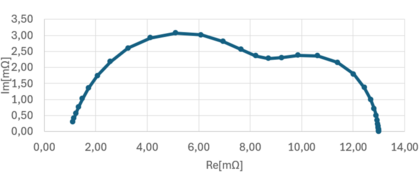
The results are typically presented in a Nyquist plot. Figure 1 shows the Nyquist plot of a typical alkaline electrolyzer stack.
Economic Benefits
Integrated EIS improves the economic viability of electrolyzer plants through early fault detection, optimized operation, predictive maintenance, and extended stack lifetime. For a 10 MW electrolyzer plant, an efficiency improvement of just 1% can result in annual electricity savings of approximately 500 MWh. At an electricity price of €60/MWh, this corresponds to annual savings of around €30,000.
Extending stack lifetime from seven to eight years can additionally reduce stack replacement costs by a six-figure amount over the plant's lifetime. Together, these benefits contribute to lower maintenance costs, higher plant availability, and a reduced Levelized Cost of Hydrogen (LCOH).
Early Detection of Degradation and Faults
EIS enables the identification of various aging mechanisms and operational issues, including:
Membrane and catalyst degradation
Electrode aging and mass transport limitations
Insulation faults and leakage currents
Inadequate water, gas, and thermal management
Changes in the impedance spectrum can indicate emerging problems before significant performance losses occur. This enables predictive maintenance, reduces unplanned downtime, and improves plant safety and availability.